01 de novembre, 2010

Testing the Monvínic Experience

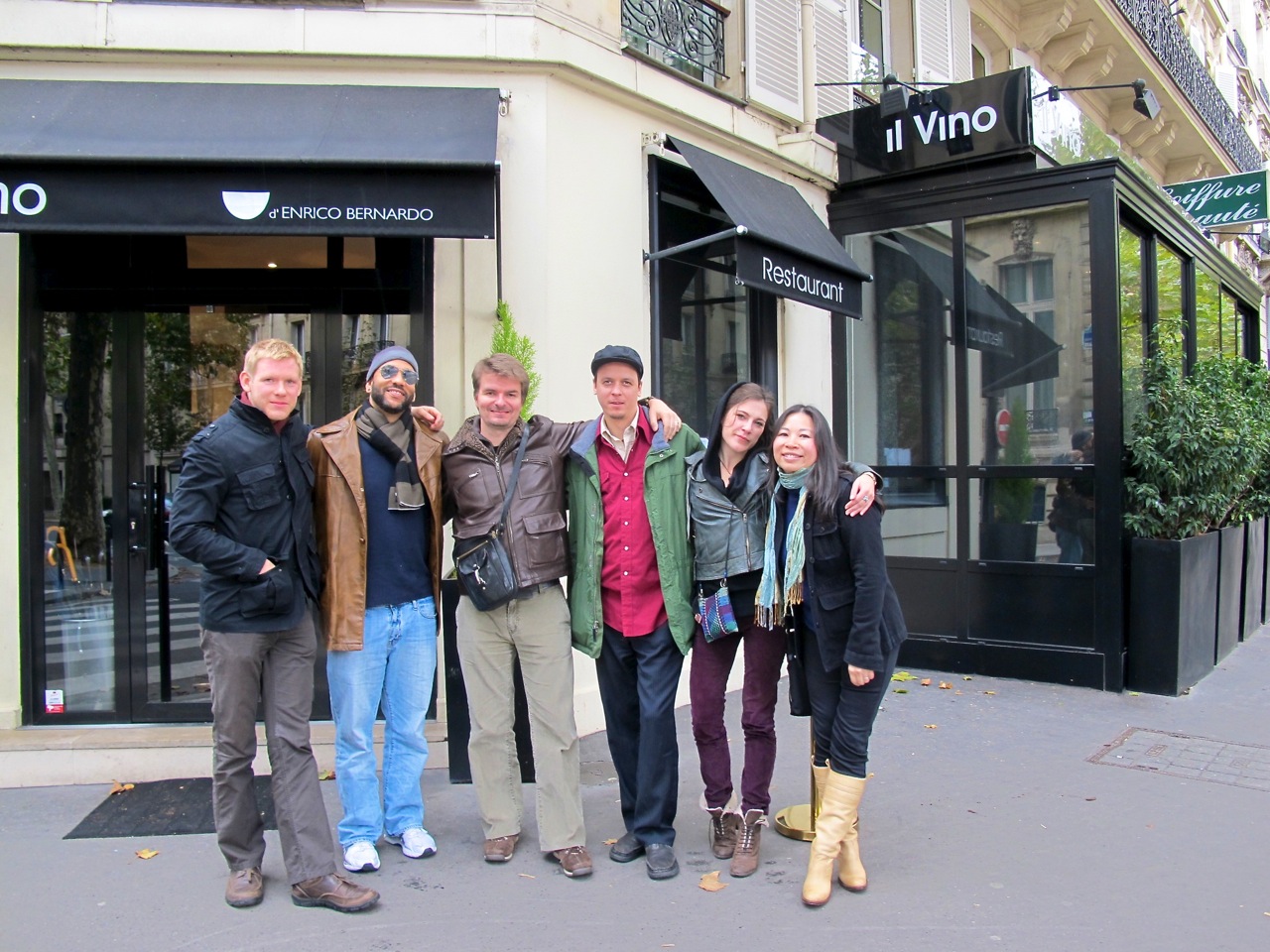
 Kurt's party in front of Il Vino d'Enrico Bernardo in Paris.


On Sunday October 31st, at the beginning of his European Standards Trio tour, Kurt Rosenwinkel and his team were in Paris having lunch at the one star Michelin restaurant Il Vino d'Enrico Bernardo. This was in order to taste the wines selected for the Monvínic Experience on November 15th (already sold out; for waiting list, please call +34 93 272 61 87). The event in Paris was arranged on the kind invitation by the Fundació de Música Ferrer-Salat and the Barcelona Jazz Festival. Anders Chan-Tidemann, Kurt's manager since 2002, was also there, and we asked him about their impressions of a very special lunch.

Here is his special report from Il Vino d'Enrico Bernardo.


By Anders Chan-Tidemann

Arriving to Il Vino in Paris @ 1pm on a cool Sunday, a bit grey and dull in weather although not too cold. The restaurant seems closed except when walking up close, and when walking inside we are the first ones there, no-one else is eating yet. The interior of the restaurant is elegant but not too upscale or with any feeling of "arrogance" - just quietly classy. The curtains are of the kind where you can look out easily, but you can't really look in, so from the inside the restaurant appears brightly lit and welcoming.

We don't know what to expect and the first dish gives nothing away. A small terrine with lamb, eggplant and something else which I forget + selleri foam in a small cup.


The three sea scallops.

But then comes the first dish - 3 sea scallops with 3 different "toppings" to give different flavor. One is flowery, another has a piece of mandarin and the 3rd a delicious piece of very special and famous Japanese seaweed. The scallops themselves are delicious but the piece of sea-weed is making it truly outstanding! The white wine served is very "big" in character, flowery too without being overly sweet.

Second dish is cod-fish. Not normally a favorite fish of mine, but this one is done to absolute perfection. The skin, too, is crispy and tasty. The white wine served with this dish (Taleia 2009) is outstanding –one of the best I've ever tasted, certainly, and that's the universal feeling around the table. Everybody loves this wine! It starts out "smaller" than the first wine, but then "grows" and has a superb finish!


The white wine: Taleia 2009.

Kurt Rosenwinkel is already developing the musical ideas to compliment the wines, and he, Eric Revis and Ted Poor are all discussing the wines and their characters, and start translating these into tonal centers and keys.

The third wine, a red wine (Clos Mogador 2001), is also magnificent. It's served with veal, mushrooms and spinach. The food is, again, excellent, but the wine takes the prize. It also perfectly compliments the white wines that preceded it.


Kurt tasting the red wine Clos Mogador 2001.

After the 2nd glass of white wine Kurt had decided that we were "only" going to taste 4 wines on this day, in order not to get too "wined-up" prior to having to perform later on that evening. So the last wine we get on this day is a dessert wine. It, too, is excellent. Very big in flavor without being TOO overly sweet, but so big that Eric Revis felt like it needed the desert - the photo of which is attached below - which did indeed compliment the wine perfectly, giving it the balance in flavors. 

Walking out of Il Vino d'Enrico Bernardo we all felt totally satisfied and that we had received a food an wine experience we won't soon forget. Now it's up to Kurt to match this with music that the audience won't forget, but I feel confident to say that he, too, is a master of serving tasteful (sound-) bites, so I think everybody will have something to look forward to at Monvínic, in Barcelona, on Nov. 15.

The end of lunch: 4 wines tasted, 2 more for the route…

Sonny Rollins a 'El Punt'

En conversa amb Guillem Vidal, Sonny Rollins és avui protagonista d'una molt bona entrevista a les pàgines d'El Punt.

Heus aquí un petit tast de la conversa de Vidal amb el Colós.


Des del 1966 fins al 2007 ha actuat a Barcelona en diverses ocasions. Quines emocions li desperta la ciutat? Tinc la sensació que sempre he ofert bons concerts a Barcelona, tot i que no sé del cert què els van semblar a la gent. Del 1966 recordo que se'm va entregar un diploma que encara tinc penjat a la paret. És, doncs, una ciutat a la qual estic encantat de tornar.

Quan sap que un concert ha estat perfecte? No crec que hagi assolit el màxim nivell de perfecció, tot i que, lògicament, he fet concerts millors i pitjors. Actualment, sento que sóc més capaç que mai de fer concerts pròxims a l'excel·lència, i que toco bastant millor de quan vaig començar. Practico cada dia com he fet sempre sense excepció, ja que em caldrien unes quantes vides per sentir-me plenament satisfet.

Quan toca, què vol aconseguir? Intento fer sortir una veu interior que no sé exactament d'on prové però que sé que tinc en mi des que era un nen. Sovint se'm pregunta: què li passa pel cap, quan fa tots aquests solos?, i la resposta és clara: quan toco, no penso. És impossible pensar i tocar jazz a la vegada. Cal deixar que la música s'expressi per si mateixa i confiar en l'inconscient, l'interior, l'esperit.

Què ha aportat el jazz a la humanitat? El jazz fa sentir la gent esperançada, ja que la vida és prou complicada com per voler-la viure dues vegades. El jazz fa sentir-nos bé, ens manté els ulls ben oberts i ens fa ser conscients que hi ha un Déu, un paradís, o alguna cosa bona al món. És una virtut de la música en general, però especialment del jazz.


L'entrevista completa, aquí.


31 d’octubre, 2010

Sonny Rollins en 'El País'

Sonny Rollins, en su última actuación en Barcelona, en el 2007 (foto: Ricard Cugat).

El periódico El País publica hoy una entrevista con Sonny Rollins, firmada por Iker Seisdedos. Reproducimos cuatro de sus preguntas.

¿Diría que tocar el saxofón es su emoción favorita?
No hay nada de lo que esté más seguro. Y créame, lo sé hace nada menos que 72 años. Tenía ocho cuando vi un saxo por primera vez y sigo tocando con la misma pasión y el mismo entusiasmo. El día que acerté dos notas seguidas tuve claro que había nacido para esto.

¿Sintió en algún momento que competía con alguno de sus pares?
 La gente decía 'Sonny está tocando mejor que Coltrane' y cosas así. Luego te haces mayor y te das cuenta de que solo un estúpido de remate deja de escuchar a Johnny Hodges al descubrir a Charlie Parker. Es una cuestión de madurez, el único antídoto contra la tontería. Esto no es pop, hijo, esto es jazz, es música de verdad, no hay emociones de contrachapado, las cosas suceden, la gente se hace daño, ríe y llora todo el rato.

¿Considera el jazz una música culta?
Hay quien ve mi arte como algo complicado, a mí me resulta sencillo. Es difícil poner la música en palabras, pero yo la describiría con una escena. Tengo 10 años, estoy practicando en casa, es domingo, el resto de los chicos juegan en la calle, roban en las tiendas... Llevo 10 horas en un rapto de conciencia. Toco y toco. Llega mi madre y dice: 'Sonny, cariño, es la hora de cenar, así que haz el favor'. Eso es la música para mí, algo que me hace olvidar que tengo que alimentarme para sobrevivir.

¿Añora los viejos tiempos, cuando las cosas importantes se guardaban bajo la cama?
En absoluto. Toco mejor que en los sesenta. Mejor que el año pasado.
La entrevista completa, aquí.

En apenas tres días, Sonny Rollins regresa a Barcelona e inaugura oficialmente el 42 Voll-Damm Festival Internacional de Jazz de Barcelona. Pocas, pero aún quedan entradas.

30 d’octubre, 2010

Afrocubism, en 'The New York Times'


El próximo martes, 2 de noviembre, Afrocubism, la idea del productor Nick Gold que terminó convirtiéndose en Buena Vista Social Club, empieza su gira mundial en Oslo, con parada el 18 de noviembre en L'Auditori, dentro del 42 Voll-Damm Festival Internacional de Jazz de Barcelona.

Ben Sisario, en The New York Times, publicó ayer un denso y documentado artículo sobre Afrocubism, que también se detiene en Nueva York, el próximo 9 de noviembre en el Town Hall.

Así empieza el artículo.

It became the most successful world-music album in history, but “Buena Vista Social Club” happened by accident.
The original idea for the record, as conceived by Nick Gold of the British label World Circuit, was to bring a group of prominent African musicians to Cuba for an intercontinental jam session. But when visa delays thwarted the Africans’ travel plans, Mr. Gold and his producer, Ry Cooder, improvised by inviting some Havana old-timers into a studio there and voilà. The resulting “Buena Vista” album, recorded in 1996 and released a year later — a slow, romantic stroll through the sounds of prerevolutionary Cuba — sold eight million copies, won a Grammy and spawned more than a dozen solo albums.

La continuación del artículo de Sisario, aquí. Para información sobre el concierto de Barcelona, he aquí el enlace. Y otro artículo, en este caso publicado por El País, relacionado también con Afrocubism.